

What is neuromarketing and how can it make advertising campaigns more effective?
Neuromarketing is a discipline that combines neuroscience, consumer psychology, and marketing to better understand the decision-making processes that drive human behavior. Unlike traditional methodologies based on surveys and interviews, neuromarketing analyzes biological and neurological responses, such as emotion, attention, and memory, to find out what really influences purchase choices.
Underlying neuromarketing is consumer psychology, with behavioral theories such as Kahneman and Tversky's prospectus, which highlight how people's decisions are not completely rational but influenced by emotions, cognitive biases, and contexts. For example, the fear of loss often weighs more heavily than the desire for an equivalent gain. Other theories, such as Herbert Simon's bounded rationality, explain that people tend to make "good enough" decisions using mental shortcuts (heuristics).
Cognitive bias: the decoy effect
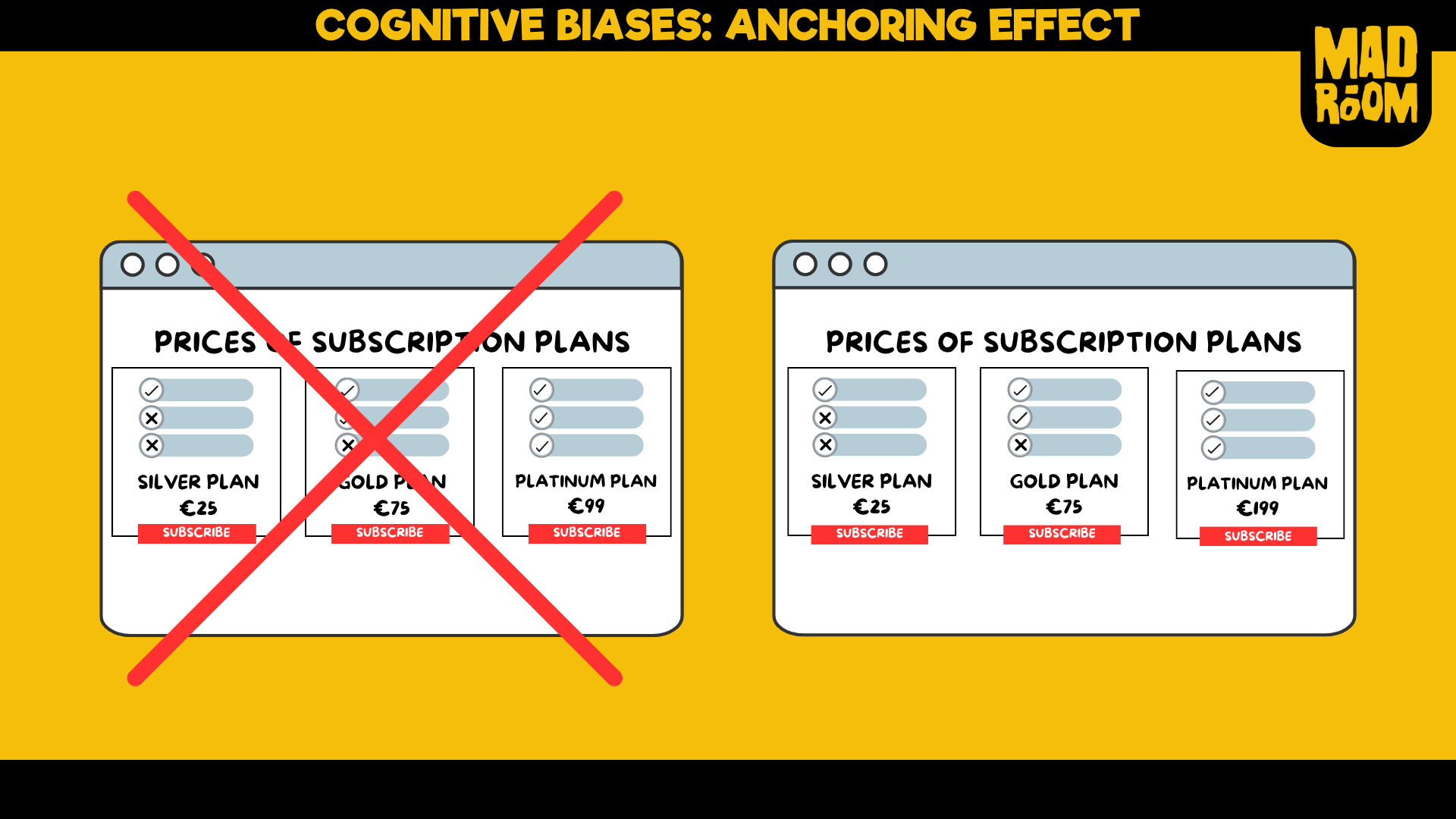
The decoy effect, first demonstrated in 1982 by Joel Huber at Duke University, is a cognitive bias that strongly influences consumer choice. When a customer is undecided between two options, introducing a third "asymmetric" option (decoy) can steer the decision toward one of the two initial options. Our brains prefer to evaluate options by comparison rather than in absolute terms, making the decoy effect a powerful neuromarketing strategy.
This bias is often used to influence sales through price perception: the decoy option is designed not to be chosen, but serves as a third term of comparison that values the desired option.
Practical example:
Suppose you wish to incentivize customers to choose the "Gold" tariff plan. By introducing a third "Platinum" option, similar but with a significantly higher cost, the "Gold" plan will appear more convenient and beneficial, thus prompting customers to choose it. The "Platinum" option acts as a decoy, making people perceive better value for money on the "Gold" plan.
Why is neuromarketing essential for brands?
Neuromarketing becomes a key tool for brands because it allows them to overcome the limitations of traditional research. You don't ask consumers what they think, but you directly observe how they react. This approach allows you to:
- Create more effective advertising campaigns, which directly strike the emotions and stick in the memory.
- Optimize design of products, websites, and stores to improve the user experience.
- Understand why certain visual stimuli, sounds, or messages work better than others.
In summary, neuromarketing not only helps companies better understand their consumers, but also offers tools for making more authentic and deeper connections, improving the effectiveness of communication strategies and increasing customer satisfaction.
Unlike traditional methods, such as surveys and interviews based on explicit statements, neuromarketing directly observes how the brain and emotions actually react.
Eye tracking and the Gaze Point: observing visual attention
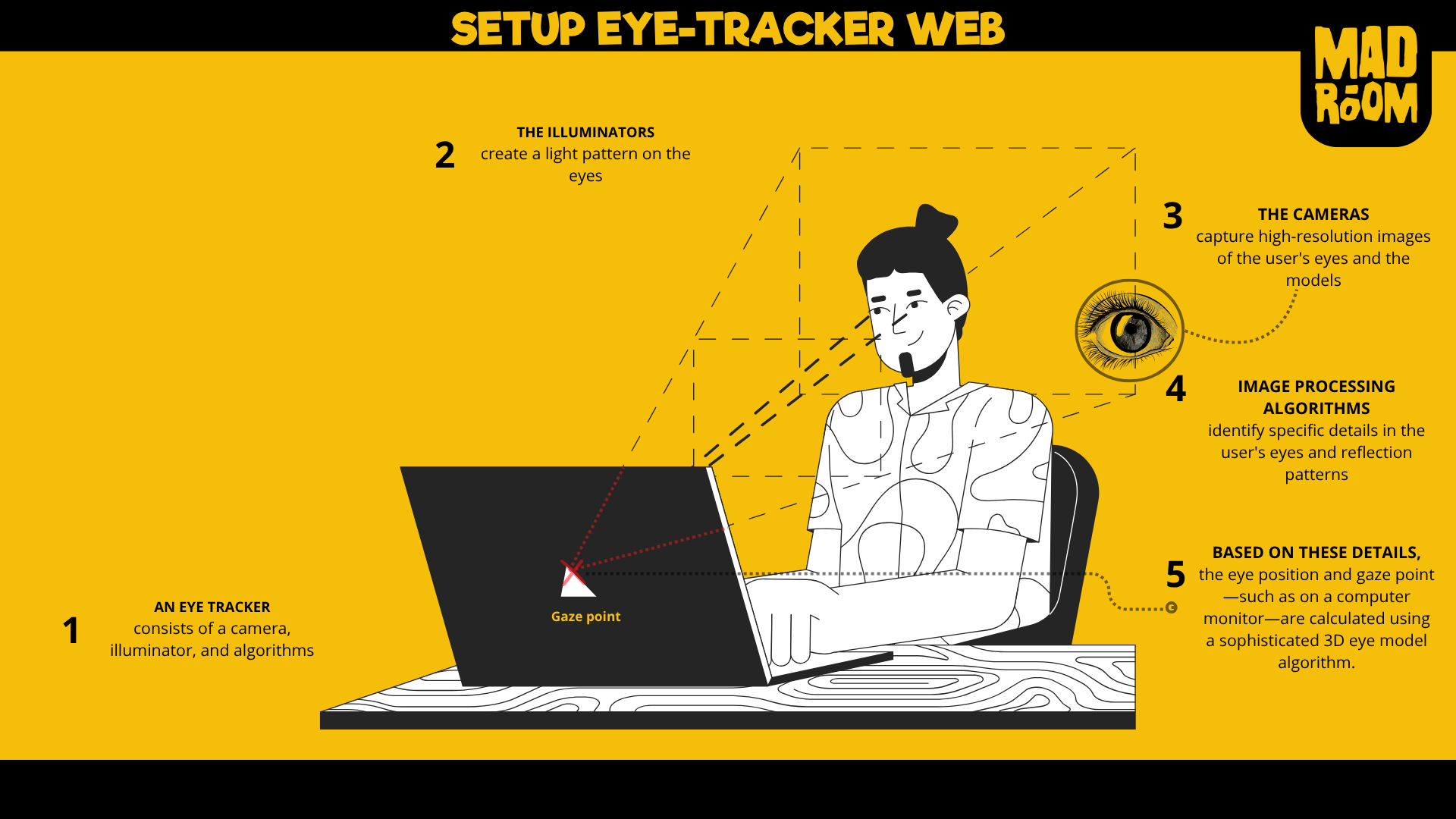
Among the most widely used techniques in neuromarketing, eye tracking is an essential tool for understanding how people visually interact with a piece of content. This method monitors eye movements to detect:
- Gaze point: Where the gaze focuses.
- Fixation duration: How much time is left on an element.
- Order of exploration: The sequence in which the eye explores different parts of an image or interface.
Eye tracking provides valuable data to optimize advertisements, packaging, websites and point-of-sale. It enables the identification of immediately attention-grabbing or ignored elements, thus placing key messages in the most visible places and improving the effectiveness of call-to-actions.
A classic example is the packaging of products on the shelves of a supermarket: eye tracking shows which colors, shapes, or arrangements most attract the consumer's eye, guiding purchase decisions. Using gaze point combined with technologies such as visual heatmaps provides a clear representation of the areas that generate the most visual interest, helping to optimize aesthetics, usability and effectiveness of the message conveyed.
This type of analysis goes beyond simple eye-tracking: it offers an immersion into consumers' cognitive processes, revealing what really captures their attention and how emotions influence what they remember.
How Neuromarketing makes advertising campaigns more effective
Emotional storytelling and the power of emotions
Emotional storytelling is extremely powerful because it connects directly to the human brain. When we listen to an engaging story, our brains do not simply process information, but are activated on multiple levels, stimulating regions such as the amygdala (associated with fear) and the limbic system (associated with emotion). This process creates vivid and lasting memories.
Neuromarketing leverages this dynamic to make messages more impactful, selling not just products, but emotions, dreams, and values. For example, advertising campaigns that tell stories of resilience and personal transformation create a deep connection with the audience. A well-constructed narrative stimulates the release of dopamine, solidifying the lived experience in memory.
The science behind A/B testing
A/B testing is a powerful tool in neuromarketing, allowing you to compare different versions of a piece of content to identify the one that generates the most intense emotional response. Techniques such as eye-tracking and facial microexpression analysis provide objective data on users' emotional engagement, going beyond simple clicks and conversions.
For example, comparing an emotional image with a rational communication allows one to determine which version resonates more with the audience and generates lasting connections.
Neuromarketing on social media
On social media, where attention is short, neuromarketing becomes essential. Some key techniques include:
- Visual shots: Captivating images and videos.
- Emotional elements: Intriguing titles or instant stories.
- Strategic call-to-action: Placements designed to maximize attention.
For example, a short, dynamic video with emotional images can strongly stimulate user engagement.
The role of emotions in B2B marketing
Even in B2B marketing, emotions deeply influence decisions. Neuromarketing helps combine emotional messages with practical benefits, building trust and conviction. A successful case study, accompanied by images that convey collaboration and concrete results, can be more effective than a simple list of technical features.
Creating memorable advertisements
Effective advertising must stick in the memory. Neuromarketing uses:
- Priming: Associating the brand with positive emotions.
- Associative conditioning: Connect a product to familiar and reassuring experiences.
For example, the use of nostalgic melodies can evoke personal memories and strengthen the emotional connection to the brand.
Buying choices: emotions versus rationality
Buying decisions are often based on unconscious perceptions: a beautifully designed product looks better, or a well-known brand conveys confidence. Neuromarketing shows that emotions are not just part, but the main driver of our decisions.
Every sensory and emotional detail helps transform products into meaningful experiences, strengthening the brand-consumer bond.
Conclusions
Neuromarketing emerges as a crucial approach to understanding and influencing consumer behavior. It overcomes the limitations of traditional research by creating deep connections between brands and audiences through effective storytelling, multisensory experiences, and data-driven strategies.
Using advanced techniques such as A/B testing, sensory analysis, and emotional campaigns, companies design memorable and engaging advertisements, including in B2B marketing, reinforcing emotional connection and turning products and services into meaningful personal experiences.